

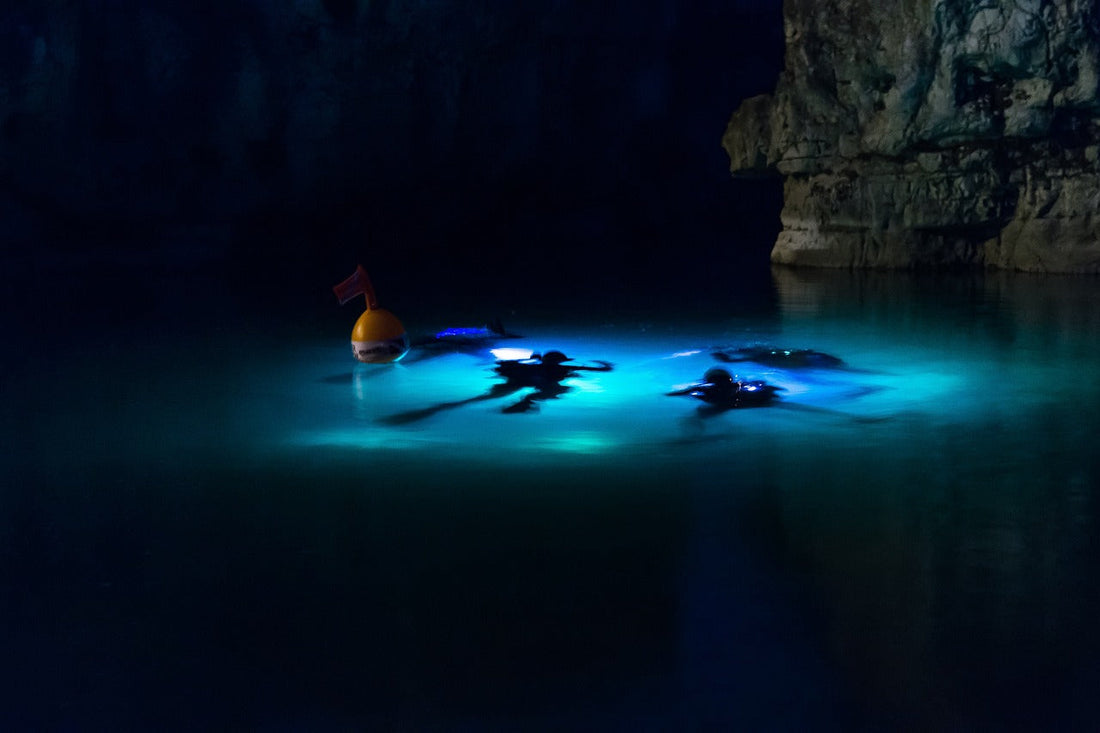
Night diving: a magical experience to discover
Imagine this: you descend slowly underwater, in total silence, guided only by the beam of your dive light. Around you, reflections dance, marine creatures you never see during the day emerge from their hiding places, and time seems to stand still. Welcome to the hypnotic world of night diving.
Whether you're curious, passionate, or simply looking for a new experience, night diving is a true sensory adventure. In this article, we'll take you on a complete exploration of this magical activity: equipment, safety, marine life to observe, and tips to help you enjoy your first dive in the dark. Ready to dive differently?

What exactly is night diving?
Night diving is like entering another world. Once the sun sets, the seabed transforms. The colors change, the marine life comes alive in a new way, and your connection to space and silence becomes incredibly intense. If you've ever felt awe underwater during the day, just wait until you see what it's like at night.
Spoiler alert: it's magical, a little creepy at first... and totally addictive.
Why try the experiment?
1. A timeless atmosphere
Night diving is like stepping through a doorway to another world. Deprived of your usual points of reference, you let yourself be carried away by the darkness, guided only by the beam of your headlamp. Sounds are muffled, movements slowed, every sensation becomes more intense. The ocean, usually so familiar, transforms into a mysterious universe where every detail takes on a new dimension.
2. Discover other marine life
At night, many species emerge from their hiding places: octopuses, moray eels, crustaceans, hunting fish, fluorescent plankton… It’s a ballet of creatures!

3. Develop your diving skills
Night diving improves your concentration, buoyancy control, and underwater communication. It's a real asset to your diving journey.
Is this for me?
You don't need to be an expert diver. A Level 1 (or Open Water) certification and comfort underwater are generally sufficient. Night dives are always initially supervised in a safe environment.
Tip: Start with a dive at the end of the day (sunset) for a smoother transition to darkness.
What can you expect during a night dive?
-
Enhanced safety briefing : we explain the light signals, the dive plan, the group rules.
-
Equipment with main lamp and emergency lamp .
-
Departure from the beach or by boat depending on the spots.
-
A gentle descent , guided by the light.
-
Calm exploration with slow movement so as not to frighten the wildlife.
-
Return to the surface with signaling (lamp on the vest, light-up parachute if necessary).

What you'll see (and love) underwater
-
Fluorescent corals and bioluminescent plankton
-
Nocturnal crustaceans ( lobsters, giant crabs)
-
Predatory fish such as scorpionfish, barracudas or conger eels
-
Octopuses , cuttlefish , and moray eels are more active at night .
-
An ultra-quiet, almost mystical atmosphere
Specific equipment for a successful night dive
The diving lamp
The essentials. Choose:
-
A powerful main lamp (between 500 and 1000 lumens minimum)
-
An emergency flashlight (always in your BCD pocket or attached)
The buoyancy aid vest with signaling
An LED flash on your BCD makes you visible in the dark. Some centers provide them; otherwise, consider buying one.
suitable combination
The temperature often drops at night: a thicker wetsuit can be useful, even if you are used to diving in a shorty.
Useful accessories
-
Light sticks (to clip onto your bottle or arm)
-
Light-up parachute (useful if you're ascending at a different time than the group)
-
Waterproof tablet or slate for communicating in the dark
- Your microfiber towel or bath poncho to stay dry after your dive
Tips for your first night dive
-
Do it with a club : professional coaching, equipment provided, relaxed atmosphere
-
Stay close to your partner : communication is visual, so it's important to see each other.
-
Master your buoyancy before you set off: no unnecessary kicks of your fins in the sand
-
Avoid shining your flashlight in the eyes or at animals
-
Be calm and slow : at night, any rapid movement stresses the fish (and humans).
Best spots for night diving in France (and elsewhere)
-
The Côte Bleue Nature Reserve (Provence) : gorgonians, octopuses and barracudas
-
Cap d'Agde : a lunar atmosphere and active wildlife
-
Port-Cros (Var) : Shipwrecks and groupers by torchlight
-
Guadeloupe and Martinique : bioluminescent plankton, sleeping turtles
- Reunion Island : At Atoll Plongée , we regularly offer guided night dives to introduce beginners to this magic.
-
Bali / Raja Ampat : paradise for nudibranchs and fluorescent corals
And what about safety in all of this?
-
Never dive at night without supervision or a buddy.
-
Always carry a main light + a backup light
-
Avoid areas with strong currents or poor visibility
-
Signal your presence on the surface with a lighted buoy or BCD flash.
-
Stay within the depth outlined in the briefing
Bonus: reputable centers will explain everything in detail during the briefing. Trust the pros!
Night diving is also practiced all over the world!
Here is a list of our favorite diving spots .
Did you know there was a global event dedicated to that?
Diversnight: World Divers' Night
Every year, thousands of divers gather on the same evening all over the world to dive at the same time. A true global underwater communion.
To learn more: https://en.wikipedia.org/wiki/Diversnight
What night diving brings you (beyond the thrill)
-
Better stress management
-
Greater autonomy
-
Better concentration underwater
-
An even more emotional and contemplative relationship with the ocean
-
And often… unforgettable encounters with the sea
FAQ: Frequently asked questions about night diving
Is it dangerous to dive at night?
No, provided you are properly supervised, well-equipped, and follow the safety instructions. It's actually one of the calmest dives!
As the INPP (National Institute for Professional Diving) explains very well, night diving requires specific preparation and a defined environment to be practiced safely. According to DAN – Divers Alert Network , night diving offers a unique atmosphere but requires very specific precautions.
Is a special level of education required?
Not necessarily. Level 1 or Open Water is sufficient in most clubs.
Which lamp should I choose to start with?
A waterproof lamp of at least 500 lumens, rechargeable, with a wide beam and good battery life (1 hour minimum).
Can you see more at night?
Different, yes! Fewer colors but more active wildlife. And with the lamp, the colors stand out better than in broad daylight beyond 10 meters.
Is it possible to take photos while diving at night?
Absolutely. You'll need an external flash , a focusing lamp , and a good waterproof housing . It's a whole different world.
Conclusion
Diving at night is like rediscovering the ocean with new eyes. Every bubble, every light, every creature becomes magical. If you want an unforgettable sensory experience, go for it. Breathe, illuminate, explore… and let yourself be amazed.
Article updated in August 2025